

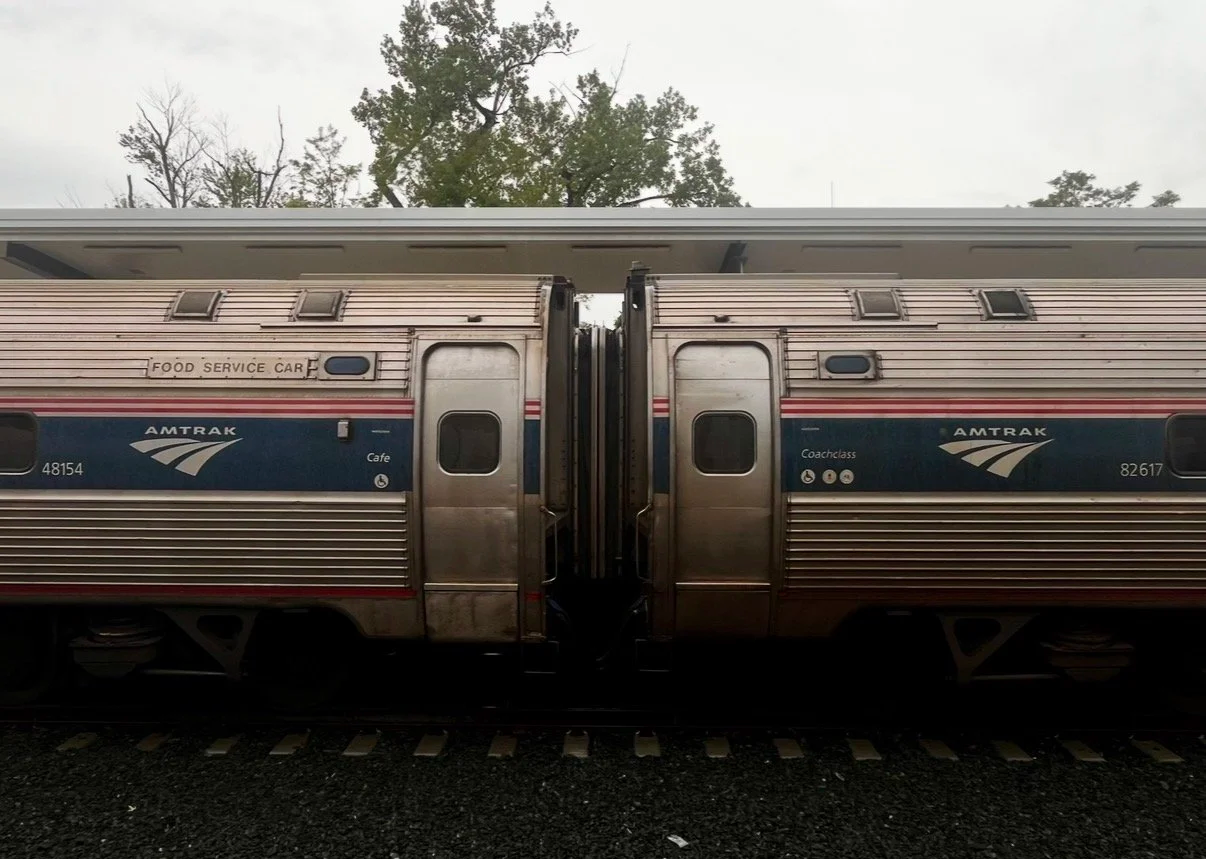
Aging Empire Service Amtrak passenger cars at the Louise M. Slaughter Rochester Station in downtown Rochester, New York.
For years, I have contemplated what high-speed rail (HSR) could look like in the United States. The dramatization of these rails has unfolded in my mind over and over like a Wes Anderson original: highly stylized, tinted, symmetrical, and surprisingly nostalgic for a world that does not exist yet, in the U.S. I have traveled frequently by train, enjoying the seated comfort, the flexibility to walk about, grab a snack or a cold beer from the cafe cart, and stare out the windows at those panoramic views of nature, winding rivers, quaint towns, and the American dream. Yet, as the years have passed, I have remained both hopeful and underwhelmed by the stunted realization of these fast-moving vehicles in our country.
Presently, the NextGen Acela trains have been introduced to the Northeast Corridor (NEC) in August 2025, and high-speed trains were launched this year for service on the Amtrak Cascades in the Pacific Northwest. Yet, while there is much anticipation for this gradual shift towards high-speed rail on both coasts, the significant impact that the new Amtrak Airo trains will have on New York State when it finally comes to fruition remains unsung. Especially when considering the Empire Service which travels from New York City to Albany, and stops at every major upstate city including Syracuse, Rochester, and Buffalo on to Niagara Falls.
Why is this so important? I argue it is because a high-speed rail in the Empire State would effectively connect upwards of 4 to 5 million residents to each other and New York City. This would bring a population of over 12 million people closer together by faster rail services.
Let me clear the air, I get it, it’s easy to overgeneralize Upstate New York cities as predominantly car-centric due to the lack of good public transit infrastructure, especially when comparing these cities to New York City or Chicago. However, this past year, many of the largest Upstate cities like Rochester, Buffalo, Syracuse, and Albany have requested around 15% increases for public transit to ensure that their city’s transit services are maintained. Like many other transit companies, (yes this includes NYC’s MTA) operating budgets run at structural deficits. State funding and support is generally what provides more public transit offerings, and infrastructure. The designation of a high- speed rail across New York State is no different, and while many upstate drivers choose a car to travel over a train, many people generally make this decision based on the time it takes to travel by car vs rail. As of now, an Amtrak ride from Rochester to NYC is roughly 6.5 to 7 hours, that is around the same time that it takes to drive from Rochester to the big city. I tend to prefer the ease of the train for my commutes, so I prioritize transit by train over driving.
As we approach the last months of 2026, many are eager to see Amtrak upgrade their trains on the Lake Shore Limited, Empire Service, and Maple Leaf Service which offers trains from NYC to Chicago, and other in-state travel from NYC to Toronto. This past month, a local Rochester politician, Senator Jeremy Cooney (D-Rochester) advocated for a budgetary increase in funding that highlights investment in high-speed rails and other essential transportation needs in New York State.
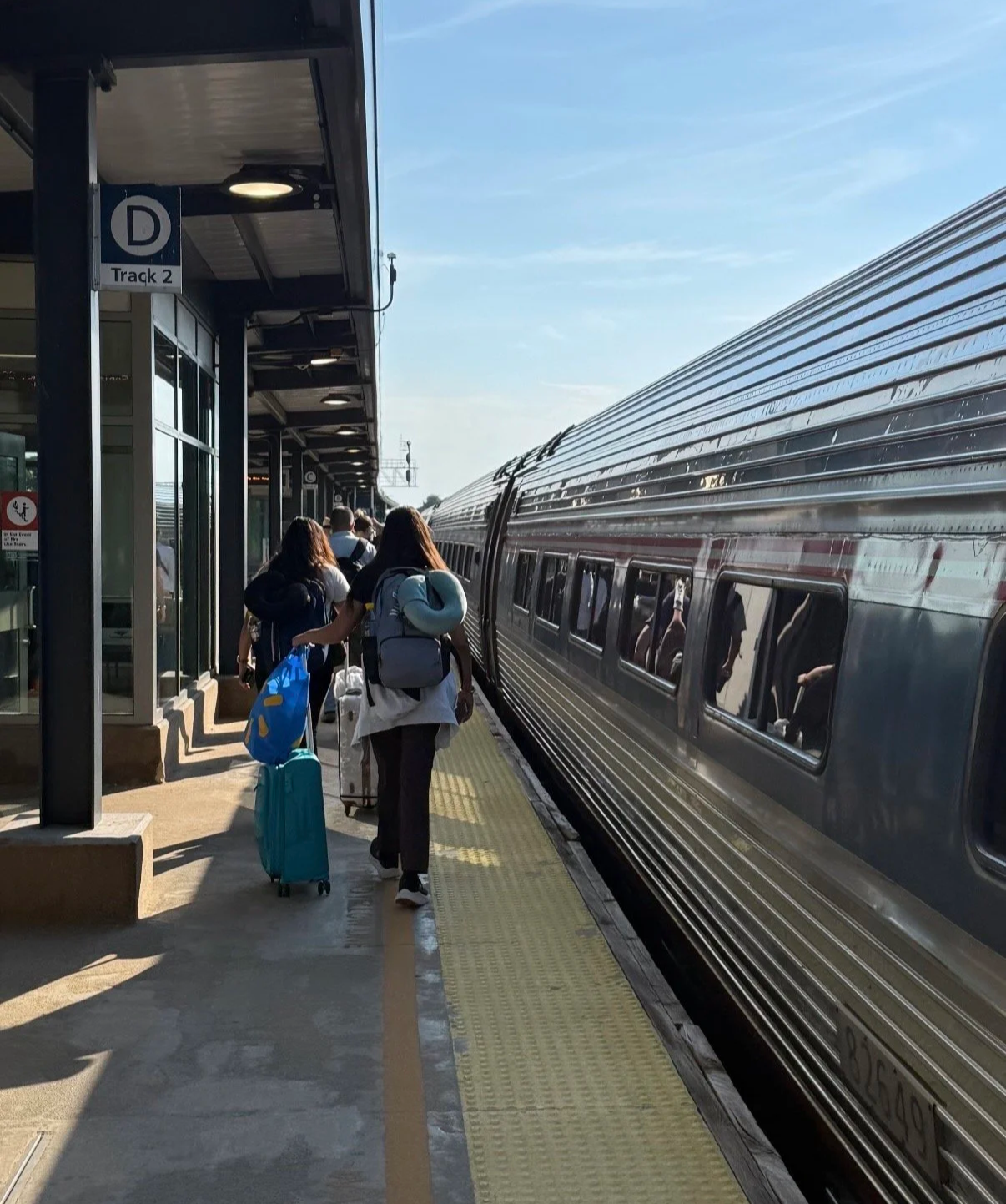
Passengers boarding the eastbound Amtrak train heading toward NYC from the Rochester Louise M. Slaughter Station.
When calculating the math, one can see how essential investment in high-speed rail could be in New York. Amtrak’s FY25 ridership saw 1,815,644 riders from NYC to Albany, Syracuse, Rochester, Buffalo, and Niagara Falls. Yet, the Empire Service still operates with outdated trains that overheat, lose WiFi signals, and need to stop for a battery swap that stalls the ride for upwards of 45 minutes in most cases. While NYS sees over 1.8 million riders, infrastructure roll outs have been prioritized in the Amtrak Cascade region an area that saw 993,000 riders in FY25 which was a decline of 8% from FY24. In 2025, NYS actually saw an increase in ridership of around 5%. .
Now I am not saying that one deserves to be invested in over the other, it turns out that a partnership between Washington State and Oregon share funds to implement this type of transit upgrade. There is not a similar coalition for funding in New York unfortunately. In a way, a push that supports upgrades between New York, Ohio, and Illinois could or rather should occur to bring high-speed rails between our cities. This should be a real consideration, given that the Lake Shore Limited from NYC generally takes upwards of 20 hours to reach Chicago, a trip that could realistically be closer to 6-hours. A high-speed rail collaboration between all three states could support a much faster commute time.
When it comes to ridership in NYS, I won’t pretend that of the roughly 1.8 million annual commutes, many of those are employees in Albany who live outside of the city, and in NYC and who travel to the capital region for work; a situation that reduces tax revenue in Albany, and one that many of the city’s leaders are working to resolve by potentially implementing a commuter tax. Albany-Rensselaer Amtrak sees roughly 790,517 riders due to this frequent activity. However, it should still be noted that there are over 500,000+ annual trips by rail in Upstate, New York if you factor out the NYC through Albany working commuters. A high-speed rail would likely see a major expansion of ridership if fully implemented, even at the slower speeds that we see in the U.S. compared to other Asian and European nations.
In fact when you examine the numbers closely, you can see that the top performing Amtrak Stations in all of Upstate New York outside of Albany are Syracuse’s Walsh Regional Transit Center at 138,686 riders, and Downtown Rochester’s Louise M. Slaughter Station at 130,121 riders. Downtown Buffalo’s annual ridership is roughly 48,914, and 9 miles out in the Village of Depew, their station sees about 102,050 riders. What can be gathered from this data is that many cities across New York State have dedicated transit hubs, but many residents likely prioritize car-centric travel over trains due to the lack of a high-speed rail infrastructure, and outdated and unreliable trains.
The late congress woman Louise M. Slaughter, and the namesake of Rochester’s Louise M. Slaughter Amtrak station was a major advocate for high-speed rails in New York State. Fifteen years ago while defending against funding cuts to the high-speed rail, Slaughter profoundly stated, “A high-speed rail line in Western New York (WNY) as currently planned would reduce the travel time significantly, and expand the WNY labor market to 955,562 workers, [and] would make us the 26th largest metro area in the world… In New York, high-speed rail will be our next Erie Canal.” In truth, the Erie Canal made New York a powerhouse state, and was arguably one of the catalysts that drove westward expansion across the United States. Today, a high-speed rail in the Empire State would connect millions of people across Upstate, New York by reducing travel times between Buffalo, Rochester, Syracuse, Utica, Albany, and NYC.
By my own calculations, a high-speed rail from Rochester to Syracuse, or Rochester to Buffalo would shift the commute times from about 80-minutes to between 25- 30 minutes since the city of Rochester is located in-between these two metros. By connecting these three metro regions through HSR, you effectively bridge a megametro of between 4 to 5 million people. Connect that metro to NYC, and now you’ve expanded it to a population of 12+ million people, and with max commute times at 3.5 to 4.5 hours. This is the unspoken power of high-speed rail in the Empire State, the ability to connect millions of people to great jobs, decent housing, the Great Lakes, beaches, waterfalls, Finger Lakes wineries, and all of the wonders of New York State.
