If you’ve ever had the experience of living in a city that experiences snowy conditions then you’ve likely felt the irritability of cabin fever, and like the walls are closing in on you during a harsh winter. In The Avalanche, writer-director Johnny Coffeen turns that premise into an intimate psychological thriller, trapping two former lovers inside a house swallowed by an avalanche, and by the unresolved weight of their shared romantic past.
In the film, Benny and Zoey awaken in a buried house with no memory of how they got there, or what happened between them that led to their confinement in close quarters. For the two, the outside world has been cut off by several feet of snow. During their intense isolation, they are forced to examine their past relationship, and relive the intimate, yet intense animosity that they share towards each other. As memories surface and the boundaries of time begin to unravel, their predicament shifts from a question of physical survival to something more emotionally complex. In a sense, the house that these two ex-lovers are trapped in becomes a nightmarish prison that forces them to confront their deceptive past.
In a simple twist of reality, Coffeen’s film is primarily shot in black and white, and features a simple, yet haunting build around a narrowing set. Throughout the film, it feels as though the walls are gradually caving in, maybe they are. The Avalanche is able to create a harrowing atmosphere through a sense of absence. The plot reveals an existential world beyond the cabin walls, manipulates our understanding of time, and prompts the audience and characters to uncover fact from fiction.
Coffeen uses the traditions of horror films to not simply deliver intense jolts, but to manifest in a physical sense a terrifying presence that pushes us deeper into emotional turmoil. A ringing phone and a claustrophobic room amalgamate to create a sense of delirium as you eagerly wait for the truth to come to light.
The Avalanche’s central tension rests on the performances of Alex Essoe and Lou Taylor Pucci, an acting duo who carry the intensity and intimacy of the film. Their exchanges throughout the story give a surreal, yet familiar feeling of regret, resentment, longing, and the complicated desire for closure. Something we all seek lest we cascade into interpersonal hell.
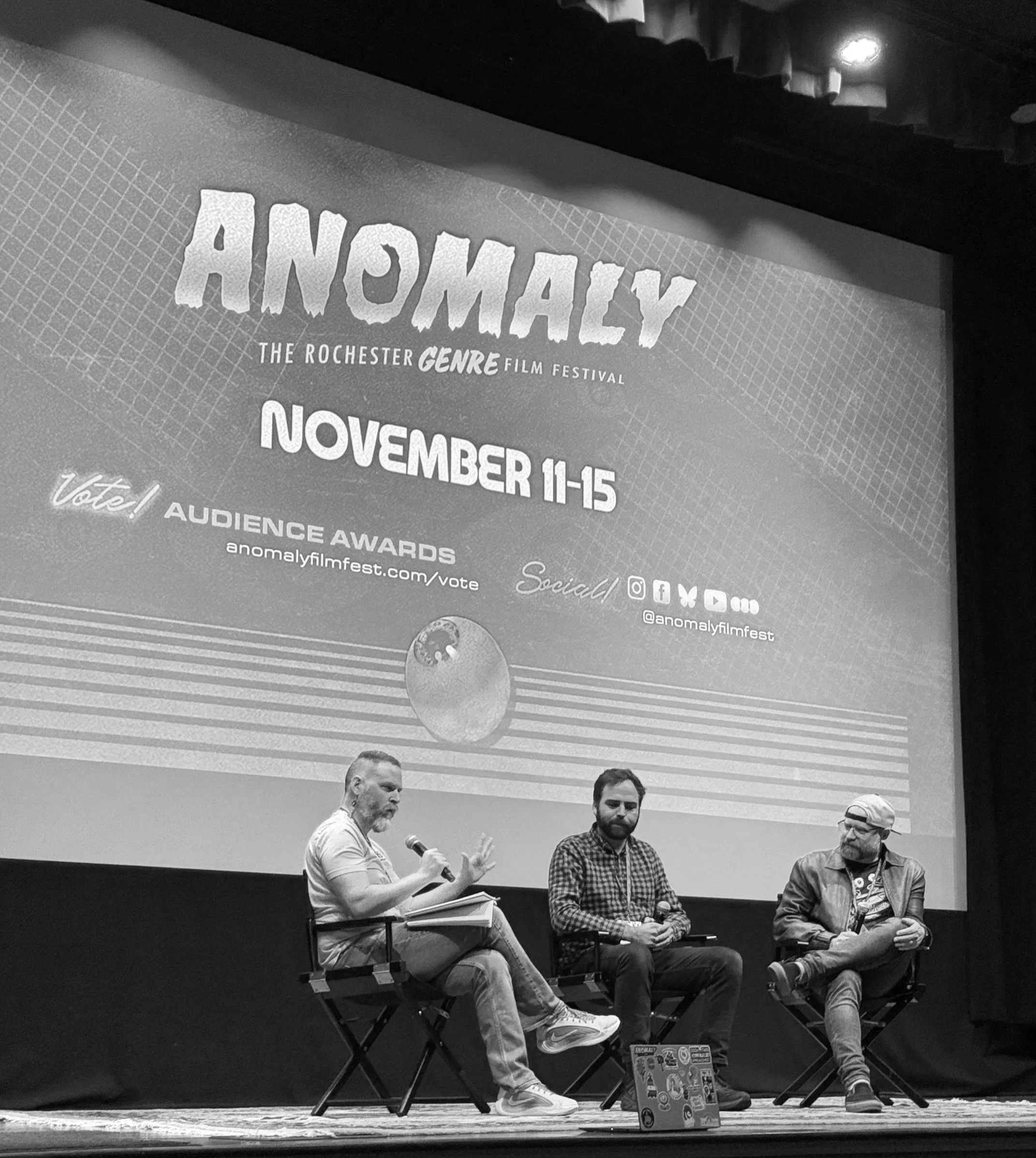
Johnny Coffeen and Andrew Scott Bell participate in a brief Q&A at the Rochester Anomaly Film Festival.
The Avalanche was screened at the Rochester Anomaly Film Festival where director, writer, and editor Johnny Coffeen led a discussion with the film’s composer, Andrew Scott Bell. Both spoke deeply about the making of the film, the tension within the creation of it, and the elements that came together to produce this intense horror flick. To close, what’s unique about the screening of this unusual picture is that in a dark and dramatic way the movie begs the question: can we really escape our pasts?